Athina Vahla : Artistic Trajectory & Selected Practice
I am a London-based choreographer whose practice over the past twenty-five years has investigated conflict, struggle, and exertion through collective encounters. Working across theatre, and site-specific performance, I create choreographic works that examine how bodies negotiate power, cooperation, resistance, and transformation. My practice is collaborative and brings together performers (trained and untrained), audience and participants to explore movement as a social, political, and embodied experience. The examples below illustrate key moments that have informed my current enquiry into cultural transmission, listening and intercultural choreographic practice.
Splinter in the Flesh (2010)
Originally commissioned as a work in progress by the British Council and Isadora Duncan Institute, Splinter in the Flesh was first developed as an R&D project at the Duncan Institute (2008) and premiered at the Athens Music Hall (2010) by the Hellenic Dance Company. The full-length work marked the culmination of a two-year exploration of identity, immigration, and otherness. As part of the process, I investigated the languages of Flamenco and martial arts, inviting expert collaborators into the studio. The stage was transformed into a gladiatorial caged arena, where the theme of "fight or flight" became a metaphor for human consciousness and its consequences.

Interdisciplinary Encounters (2011-2013)
In 2011, I was invited to South Africa to create a collaborative work for the Infecting the City festival, Cape Town. Curated by the Africa Centre and the Spier Festival, the project was supported by the British Council and the Greek Embassy in South Africa. It led to a visiting lectureship at Rhodes University, Eastern Cape, where I developed my research-led, participatory, and socially engaged approach with professional performers, students, and the local community. I conceived and curated a series of rough-hewn interdisciplinary events using sport, historical re-enactments and rituals to generate conversations with historians, geographers, psychologists, philosophers, and anthropologists.

Agon (2009-2018)
Between 2009 - 2018, I created a number of productions investigating the Greek concept of agon with boxing-based performances in the UK and South Africa. These boxing works developed over several years and formed part of the hybrid performances I named sport-theatre. Fight Club (2009) and In the Ring (2014) bookend the boxing projects.
Fight Club (2009)
A Homelands commission for Chisenhale Dance Space. I collaborated with a dancer, dance scientist, a boxer and his trainer from Repton Boys Boxing Club to investigate boxing training. The team worked together in a short, risk-taking process that looked at transforming elements of boxing training into performative action.

In the Ring (2014)
Funded by SAHUDA and Lineages of Freedom, In the Ring premiered at Box Theatre, Grahamstown bringing together professional boxers and dancers through a boxing training session, the bout, and its aftermath. I later presented the paper Defending Boxing: Performing the Agon at the Performance Studies International Conference, Shanghai Theatre Academy, in July 2014.

Japanese collaborations: Company Kyo and the Oki Islands project (2018-2020)
My collaboration with director Yuko Ijichi began in 2018 after she saw my work with Candoco Dance Company. She commissioned me to create work for her integrated company Kyo at the Tokyo Metropolitan Theatre. Following Eccyclema, she invited me back to Japan to explore how traditional Japanese dance might be reinterpreted within contemporary performance while preserving its cultural integrity.

This led to a model of “transitioning tradition” from within - working directly with source materials to retain the core of original forms while enabling contemporary reinterpretation. The resulting work, Letter from Oki, drew on movement language, rhythms, spatial patterns, and the historical and social contexts of folk dance. It premiered at Oki Islands in February 2020, just before global lockdown.
Letter from Oki (2020)
On the folk dances Kinya Monya and Shigesa Bushi, created for the Amacho Festival in the Oki Islands and the Tokyo Metropolitan Theatre.
The residency in Japan marked a clear shift in my thinking, drawing me toward East Asian performance forms and a different logic of time, transmission, and presence centred on the spaces between forms, silence, and echo. The encounter felt ongoing rather than complete, already entering my practice while remaining unresolved. At the same time, it reactivated earlier concerns around training, endurance, and contest, now reframed through this new lens.
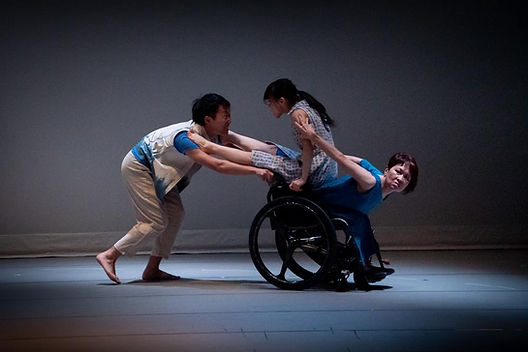
This productive tension appears in E-0923, where pre-performance becomes performance itself, and training, repetition, and bodily intelligence sit alongside fragility, cultural displacement, and leadership. Rather than a departure, this marks a reorientation that continues to shape my work across East Asian forms, Western performance lineages, and agonistic physical practice.
E-0923 (2023)
E-0923 was a collaboration with dancer and dance scientist Emma Redding, first performed at the International Association for Dance Medicine & Science conference in Washington DC in 2011, then at Trinity Laban. The work evolved through multiple iterations, culminating in a final studio rehearsal in Melbourne (2023). Combining choreography, original sound, and filmmaking, it explores navigation of new cultural landscapes and the complexities of artistic leadership within emigration.

The Gym (2026)
This trajectory finds completion in The Gym - an image-text-performance publication - part manifesto, part reflection, part artwork that makes visible a long-evolving enquiry. Moving through sporting spaces shaped by conflict, contest, and physical negotiation (boxing rings, football fields, dojos, and fitness studios), it examines how bodies are formed and tested through physical, cultural, and political forces. Supported by a research grant from Central Saint Martins, UAL, in partnership with BETTER Gyms, Camden.
Why the DYCP now?
The proposed DYCP project builds directly on these experiences and represents the next stage in a long-term shift from agonism and conflict towards methodologies of listening, stillness and the gaps between.
An established research relationship with Ah Seong Kim in London, forms the basis of this work.

A studio demonstration of Salpuri performed by Ah Seong Kim, as a reference point for this proposed enquiry.
